
Top 5 ELSS Funds for Tax Saving in 2026
Discover the best ELSS mutual funds in India for 2026 to save up to ₹46,800 in taxes while building long-term wealth through equity markets.

- NV Trends
- 5 min read
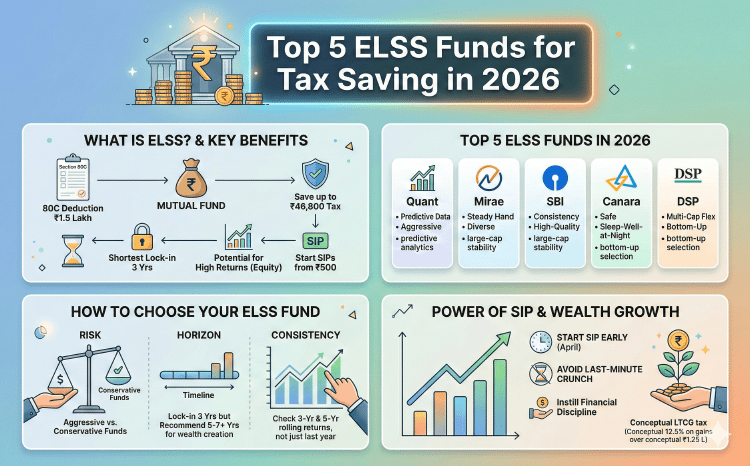
As the financial year draws to a close, millions of Indian taxpayers begin the frantic search for the best tax-saving instruments. Among the plethora of options available under Section 80C of the Income Tax Act, Equity Linked Savings Schemes (ELSS) have consistently stood out as a favorite for those looking to combine tax benefits with high growth potential.
In 2026, with the Indian economy showing robust resilience and the stock market reaching new milestones, choosing the right ELSS fund is more critical than ever. Unlike traditional options like Public Provident Fund (PPF) or National Savings Certificate (NSC), ELSS offers the shortest lock-in period and the potential for inflation-beating returns.
What is ELSS and Why Should You Invest?
ELSS is a type of equity mutual fund that invests at least 80% of its assets in equity and equity-related instruments. It is the only mutual fund category that offers tax deduction benefits under Section 80C.
Key Benefits of ELSS
- Tax Savings: You can claim a deduction of up to ₹1.5 lakh from your taxable income, potentially saving up to ₹46,800 in taxes annually (for those in the 30% tax bracket).
- Shortest Lock-in: ELSS has a mandatory lock-in period of just 3 years. This is significantly lower than PPF (15 years) or Tax-Saving FDs (5 years).
- Higher Returns: Since ELSS funds invest in the stock market, they have historically provided much higher returns over the long term compared to debt-based tax-saving instruments.
- SIP Convenience: You can start your tax-saving journey with as little as ₹500 per month through a Systematic Investment Plan (SIP).
Top 5 ELSS Funds to Consider in 2026
Selecting a fund requires looking beyond just the last one-year return. We have analyzed these funds based on their long-term performance, risk-adjusted returns, and fund manager consistency.
1. Quant Tax Plan
Quant Mutual Fund has been a disruptor in the Indian AMC space with its predictive analytics-based investment strategy. The Quant Tax Plan has consistently outperformed its benchmark and peers by being highly adaptable to market cycles. It tends to have a higher turnover ratio but has rewarded aggressive investors with exceptional returns.
2. Mirae Asset Tax Saver Fund
For investors looking for a more “steady-hand” approach, Mirae Asset Tax Saver is a stellar choice. This fund follows a growth-at-reasonable-price (GARP) philosophy. It maintains a well-diversified portfolio across large and mid-cap stocks, making it less volatile than some of its more aggressive competitors while still delivering top-quartile performance.
3. SBI Long Term Equity Fund
As one of the oldest and most respected funds in the ELSS category, this fund from India’s largest AMC has shown remarkable consistency. It is a great pick for conservative equity investors who want exposure to the India growth story through a trusted brand. The fund focuses on high-quality companies with strong balance sheets.
4. Canara Robeco Equity Tax Saver
This fund is often praised for its “sleep-well-at-night” portfolio. It focuses heavily on large-cap stocks, providing stability during market downturns. If you are a first-time equity investor moving away from FDs, the Canara Robeco Equity Tax Saver offers a perfect balance of safety and growth.
5. DSP ELSS Tax Saver Fund
DSP has a long history of managing equity portfolios in India. Their tax saver fund follows a multi-cap approach, allowing the fund manager the flexibility to pick the best opportunities regardless of company size. It is known for its rigorous bottom-up stock selection process.
How to Choose the Best Fund for You?
Not every “top” fund is right for every investor. When picking your ELSS for 2026, consider the following factors:
Risk Appetite
Are you comfortable with seeing your portfolio value fluctuate by 10-15% in the short term? If yes, aggressive funds like Quant might suit you. If you prefer stability, stick to large-cap heavy funds like Canara Robeco.
Investment Horizon
While the lock-in is 3 years, equity investments work best over 5-7 years. Only invest money that you do not need for the immediate future.
Past Performance vs. Consistency
Don’t just chase the fund with the highest return last year. Look at 3-year and 5-year rolling returns to see how the fund performed during market crashes and bull runs.
The Power of SIP in Tax Saving
Many Indians wait until March to make their tax-saving investments in a lump sum. This is a suboptimal strategy. By starting an SIP in an ELSS fund in April, you:
- Average out the cost of purchase (Rupee Cost Averaging).
- Avoid the last-minute liquidity crunch.
- Instill financial discipline.
Remember, in an ELSS SIP, every single installment is locked for 3 years from the date of that specific transaction.
Taxability of ELSS Returns
It is important to note that while the investment is tax-exempt, the returns are subject to Capital Gains Tax. Since ELSS is an equity fund, the gains are classified as Long-Term Capital Gains (LTCG). As per current rules, LTCG above ₹1.25 lakh in a financial year is taxed at 12.5%.
Key Takeaways
- Shortest Lock-in: ELSS offers the quickest access to your money (3 years) compared to all other 80C options.
- Wealth Creation: It is not just a tax-saver; it is a powerful tool for long-term goal planning like retirement or child education.
- Start Early: Don’t wait for the March deadline. Use SIPs to save tax throughout the year.
- Diversify: If you have a large tax-saving requirement, you can split your investment between two different ELSS funds to diversify manager risk.
Conclusion
ELSS remains the most vibrant and rewarding way to fulfill your Section 80C requirements in 2026. By choosing one of the top-performing funds like Quant, Mirae Asset, or SBI, you aren’t just saving on taxes—you are participating in the growth of the Indian corporate sector.
Before investing, ensure that the fund aligns with your overall financial goals and risk tolerance. If you are unsure, consulting a SEBI-registered financial advisor is always a wise move. Happy investing and happy saving!