
How to Time Your Mutual Fund Investments
Discover the truth about market timing and learn effective strategies like SIP and Rupee Cost Averaging to maximize your mutual fund returns in India.

- NV Trends
- 6 min read
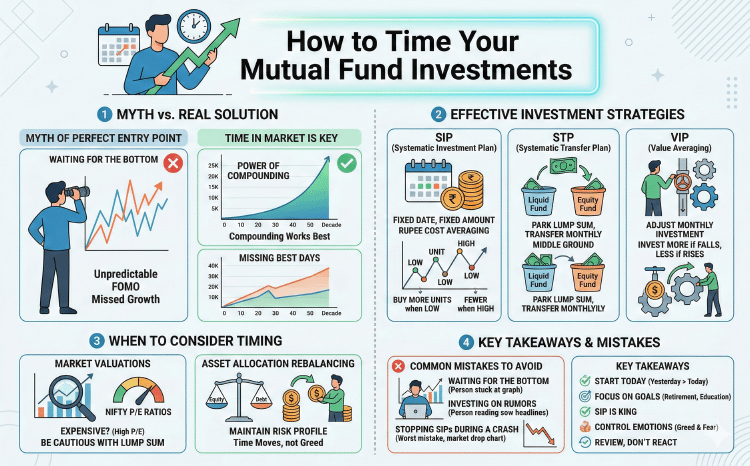
For many Indian investors, the dream is to “buy low and sell high.” We often wait for a “market crash” to put our hard-earned money into mutual funds, hoping to catch the absolute bottom. Conversely, when the Sensex is hitting new record highs, we feel a sense of FOMO (Fear Of Missing Out) and wonder if it is too late to join the party. This practice is known as market timing, and while it sounds simple in theory, it is one of the most difficult things to execute in reality.
The big question remains: Is there actually a “right time” to invest in mutual funds? In this guide, we will explore the myths of market timing, why “time in the market” is more important than “timing the market,” and the strategies you can use to navigate the volatile Indian stock market.
The Myth of the Perfect Entry Point
Many investors spend hours watching news channels or reading financial Telegram groups, looking for a sign that the market is about to turn. They believe that if they can just wait for a 10% or 20% correction, they will make significantly more money.
However, markets are unpredictable. A market that looks “expensive” today might continue to rise for another six months before correcting. By waiting on the sidelines, you miss out on the dividends and the growth that occur during that period. In the Indian context, where the economy is on a long-term growth trajectory, sitting on cash often leads to lower long-term wealth compared to being consistently invested.
Time in the Market vs. Timing the Market
There is an old saying in the investment world: “Time in the market is more important than timing the market.” This means that the duration for which you stay invested has a much bigger impact on your final corpus than the specific day you started your investment.
The Power of Compounding
Mutual funds thrive on compounding. Compounding works best when you leave your money untouched for long periods. When you try to time the market, you often end up jumping in and out of funds, which breaks the compounding cycle. Every time you sell to “protect your gains,” you lose out on the potential for those gains to earn even more money.
Missing the Best Days
Data from the Indian stock market consistently shows that if you miss just a few of the best-performing days in a decade, your overall returns drop significantly. Often, the best days occur immediately after the worst days. If you exited the market during a panic, you likely missed the subsequent recovery, which is when the most significant wealth is created.
Effective Strategies for Investing Without Stress
Since timing the market is nearly impossible for most retail investors, what should you do instead? Here are several proven strategies that work well in the Indian market.
1. Systematic Investment Plan (SIP)
The SIP is the ultimate “anti-timing” tool. By investing a fixed amount on a fixed date every month, you automatically buy more units when the market is low and fewer units when the market is high. This process is called Rupee Cost Averaging. It removes the emotional stress of deciding when to invest and ensures you are participating in the market regardless of its current state.
2. Systematic Transfer Plan (STP)
If you have a large sum of money (a lump sum) and are afraid of a market correction, an STP is a great middle ground. You can park your money in a low-risk Liquid Fund and instruct the AMC to transfer a fixed amount into an Equity Fund every month. This gives you the benefit of Rupee Cost Averaging even with a large initial capital.
3. Value Averaging Investment Plan (VIP)
For more advanced investors, VIP involves adjusting your monthly investment based on market performance. If the market falls, you invest more than your usual amount. If the market rises significantly, you invest less. This is a more active way of “timing” without completely exiting the market.
When Should You Actually Consider Timing?
While general advice suggests staying invested, there are a few scenarios where looking at market valuations makes sense:
High P/E Ratios
If the Price-to-Earnings (P/E) ratio of the broad market (like the Nifty 50) is significantly higher than its historical average, it might indicate that the market is “expensive.” During such times, you might choose to be more cautious with lump sum investments and stick strictly to SIPs.
Asset Allocation Rebalancing
Instead of “timing” to make a profit, you should time your moves to maintain your risk profile. If a bull market has made your equity portion 80% of your portfolio when your target was 60%, it is a good time to sell some equity and move it to debt. This is “timing” based on discipline, not greed.
Common Mistakes to Avoid
- Waiting for the “Bottom”: No one knows where the bottom is. You might wait for Nifty to hit 18,000, but it might turn back at 19,000 and never look back.
- Investing Based on Rumors: Social media is full of “market gurus” predicting crashes. Rely on data and your own financial goals rather than headlines.
- Stopping SIPs During a Crash: This is the most common mistake. A market crash is actually the best time for your SIP because you are accumulating units at a “discount.” Stopping your SIP during a downturn defeats the entire purpose of the strategy.
Key Takeaways
- Don’t Wait for Perfection: The best time to start investing was yesterday; the second best time is today.
- Focus on Goals: Your investment timing should be dictated by your financial goals (retirement, child’s education), not by market swings.
- SIP is King: For most Indians, a consistent SIP is the most effective way to build wealth without needing to understand complex market technicals.
- Control Emotions: Greed and fear are the biggest enemies of successful investing. A disciplined approach beats a “smart” approach every time.
- Review, Don’t React: Review your portfolio once or twice a year to rebalance, but don’t react to daily market noise.
Conclusion
Timing the market is a game of luck that even professional fund managers struggle to win consistently. For the average investor in India, the secret to success isn’t about finding the perfect day to buy; it is about having the discipline to stay invested through the ups and downs.
The Indian economy is poised for significant growth over the next decade. By focusing on your asset allocation and maintaining your SIPs, you will find that “time in the market” does all the heavy lifting for you. Stop worrying about the “right time” and start focusing on the “right habit.”