
How to Invest in IPOs Safely
Learn how to navigate the exciting but risky world of Initial Public Offerings in India with our comprehensive guide on investing in IPOs safely.

- NV Trends
- 7 min read
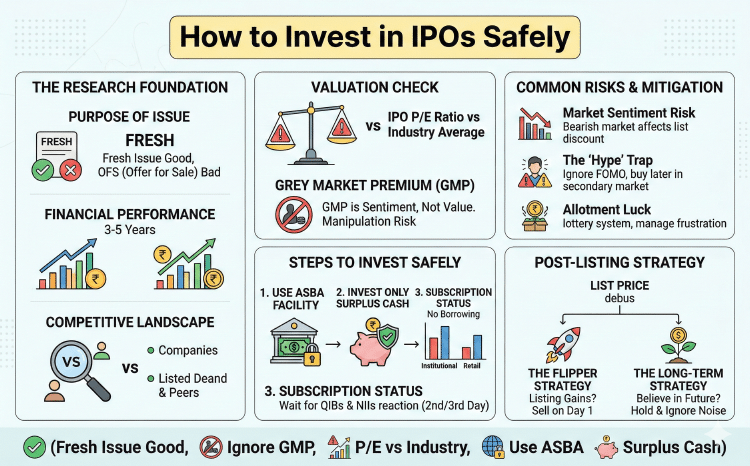
In the last few years, the Indian stock market has seen a massive surge in interest, especially when it comes to Initial Public Offerings (IPOs). From tech startups to established manufacturing giants, companies are lining up to list on the NSE and BSE. For many retail investors in India, an IPO represents a golden opportunity to get in on the “ground floor” of a promising company. However, the hype surrounding new listings can often lead to emotional decision-making, which is the enemy of safe investing.
Investing in an IPO is not just about clicking a button on your banking app or brokerage platform. It requires a disciplined approach to ensure that you are not just following the crowd into a potential value trap. This guide will walk you through everything you need to know to invest in IPOs safely and protect your hard-earned capital.
What is an IPO and Why the Hype?
An Initial Public Offering (IPO) is the process by which a private company offers its shares to the general public for the first time. By doing so, the company transitions from being privately owned to being a publicly-traded entity. The primary reason companies go public is to raise capital for expansion, debt repayment, or to provide an exit for early investors.
In India, the excitement usually stems from “listing gains.” Many investors look for companies that might debut at a price much higher than the offer price, allowing them to make a quick profit in just a few days. While this can happen, focusing solely on listing gains is a speculative strategy rather than a safe investment strategy.
The Foundation: How to Research an IPO
To invest safely, you must move beyond the headlines and social media rumors. Every company launching an IPO in India is required to file a Draft Red Herring Prospectus (DRHP) with SEBI (Securities and Exchange Board of India). While these documents are hundreds of pages long, they contain the “truth” about the company.
1. Analyze the Purpose of the Issue
Why does the company need your money? In the DRHP, look for the “Objects of the Issue” section. Safe investments are usually those where the capital is used for “Fresh Issue” to fund growth, research, or new infrastructure. Be cautious if the majority of the IPO is an “Offer for Sale” (OFS), which means existing promoters or investors are selling their shares and the money won’t actually go into the company’s growth.
2. Evaluate Financial Performance
A company might have a great brand name, but are they making money? Check the last three to five years of financial statements. Look for consistent growth in revenue and, more importantly, net profit. If a company is loss-making, ensure you understand their path to profitability before committing your funds.
3. Study the Competitive Landscape
No company exists in a vacuum. Who are their competitors listed on the Indian bourses? Compare the IPO company’s margins and growth rates with established players. If the new company is significantly weaker than existing competitors but asking for a premium price, it might not be a safe bet.
Understanding Valuation: Is the Price Right?
One of the biggest risks in IPO investing is overpaying. Just because a company is “new” to the market doesn’t mean it is worth any price.
Price-to-Earnings (P/E) Ratio
Compare the P/E ratio of the IPO with the industry average. If the industry average P/E is 25 and the IPO is priced at a P/E of 80, the company needs to have extraordinary growth prospects to justify that price. If the growth doesn’t materialize, the stock price will likely crash after listing.
The Grey Market Premium (GMP)
In India, the “Grey Market” is an unofficial market where IPO shares are traded before they list. The GMP is the premium at which these shares are trading. While many retail investors use GMP as an indicator of a “hit” IPO, it is highly speculative and can be manipulated. Never base your investment decision solely on GMP; it is an indicator of sentiment, not value.
Steps to Invest Safely as a Retail Investor
If you have done your research and decided a company is worth investing in, follow these steps to manage your risk:
Use the ASBA Facility
Applications Supported by Blocked Amount (ASBA) is the safest way to apply for an IPO in India. Instead of sending money to the company, the amount is simply “blocked” in your own bank account. The money only leaves your account if you are actually allotted shares. This eliminates the risk of waiting for refunds if you don’t get an allotment.
Invest Only Surplus Cash
Never borrow money to invest in an IPO. The stock market is volatile, and IPOs are even more so. Only use money that you do not need for at least the next three to five years. This allows you to hold through any initial post-listing volatility.
Check the Subscription Status
You don’t have to apply on the very first day. The IPO window is usually open for three days. Wait until the second or third day to see how institutional investors (QIBs) and Non-Institutional Investors (NIIs) are reacting. If the big players aren’t interested, it might be a signal to stay away.
Common Risks and How to Mitigate Them
Even with research, there are inherent risks in IPOs.
1. Market Sentiment Risk
If the overall market (NIFTY 50 or SENSEX) turns bearish during the IPO period, even a great company might list at a discount. To mitigate this, focus on companies with strong fundamentals that can withstand a temporary market dip.
2. The “Hype” Trap
Marketing agencies and brokers often create a lot of noise around an IPO to ensure it gets fully subscribed. Don’t let FOMO (Fear Of Missing Out) drive your decisions. If you miss an IPO because you weren’t sure, you can always buy the shares later on the secondary market once the price stabilizes.
3. Allotment Luck
In popular IPOs, demand far exceeds supply. Retail investors are often allotted shares via a lottery system. Don’t be frustrated if you don’t get an allotment, and don’t try to “game” the system by opening multiple Demat accounts in your own name (which is against SEBI rules). Instead, consider applying through the accounts of family members to increase your statistical chances legally.
Post-Listing Strategy: To Hold or To Fold?
What should you do once the stock starts trading?
- The Flipper Strategy: If your only goal was listing gains, sell on the first day if the price meets your target. Don’t get greedy.
- The Long-Term Strategy: If you invested because you believe in the company’s 10-year future, ignore the first-day noise. Many of India’s biggest wealth creators were once IPOs that stayed flat for months before skyrocketing.
Key Takeaways
- Read the DRHP: Always check the “Objects of the Issue” and financial health before applying.
- Avoid the OFS Trap: Be cautious of IPOs where promoters are offloading most of their stake without any fresh issue of capital.
- Ignore GMP Mania: Use Grey Market Premium as a sentiment gauge, but never as a primary reason to invest.
- Check Valuations: Compare the P/E ratio with listed peers to ensure you aren’t overpaying for “hype.”
- Use ASBA: Keep your money in your bank account until the allotment is finalized.
- Don’t Borrow: Only invest your own surplus capital to ensure you can handle potential losses.
Conclusion
Investing in IPOs can be a rewarding way to participate in the growth story of Indian corporate giants. However, the path to safe investing is paved with research, patience, and emotional control. By looking past the flashy advertisements and focusing on the underlying business fundamentals, you can separate the high-quality opportunities from the overpriced duds.
Remember, the goal of investing is not just to make money quickly, but to build wealth sustainably. Treat every IPO application as a serious business decision. If a company doesn’t meet your safety criteria, it is perfectly okay to sit on the sidelines. There will always be another IPO, but your capital is limited and must be protected.