
How Indian Mutual Funds Are Allocating Cash in 2026
An in-depth look at how Indian Asset Management Companies are managing their cash levels in 2026 to navigate market volatility and find new opportunities.

- NV Trends
- 6 min read
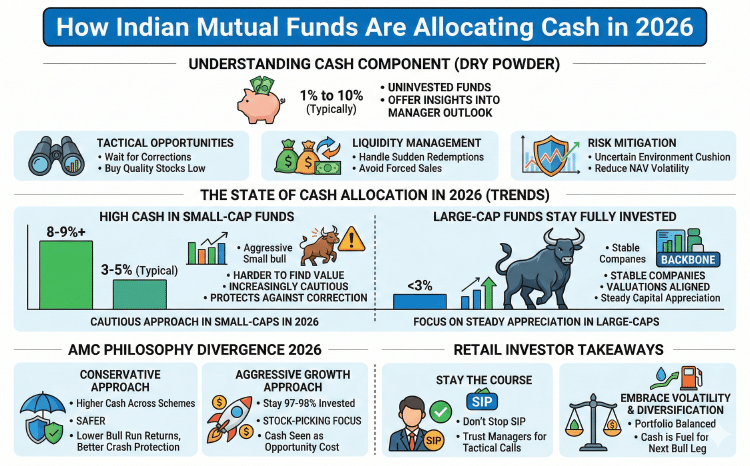
The Indian equity market in 2026 continues to be a land of immense potential and significant complexity. For the average retail investor, tracking the performance of a mutual fund is a daily habit. However, one of the most overlooked aspects of a fund’s portfolio is its cash component. Often referred to as “dry powder,” the amount of cash a fund manager holds can tell us a lot about their outlook on the market, the current valuation of stocks, and their readiness to tackle sudden volatility.
Understanding the Concept of Cash Allocation
When you invest in an equity mutual fund, you expect your money to be put into stocks. However, fund managers rarely invest 100% of the corpus into the market. They typically keep a small portion—ranging from 1% to 10% or sometimes more—in cash or cash equivalents like call money and reverse repo.
Why do Fund Managers Hold Cash?
There are three primary reasons why an Indian mutual fund would choose to hold cash rather than being fully invested:
- Tactical Opportunities: If the market is at an all-time high and valuations seem stretched, a fund manager might wait for a correction to buy quality stocks at a lower price.
- Liquidity Management: Mutual funds must be ready for redemptions. If many investors decide to pull their money out at once, the fund needs liquid cash to pay them without being forced to sell stocks at a loss.
- Risk Mitigation: In an uncertain global economic environment, holding cash acts as a cushion. It reduces the overall volatility of the fund’s Net Asset Value (NAV).
The State of Cash Allocation in 2026
As we move through 2026, we are seeing a fascinating trend among the top Asset Management Companies (AMCs) in India. After the rapid growth seen in mid-cap and small-cap stocks over the previous two years, many fund managers are becoming increasingly cautious.
High Cash Levels in Small-Cap Funds
In 2026, several prominent small-cap funds have reported cash levels exceeding 8-9%. This is significantly higher than the traditional 3-5% range. The reason is simple: finding “value” in the small-cap space has become harder. With prices reaching new peaks, managers are preferring to sit on cash rather than overpay for growth. This strategy protects the investors from a potential sharp correction in the broader market.
Large-Cap Funds: Staying Fully Invested
In contrast, large-cap funds are maintaining much lower cash levels, often below 3%. Because large-cap companies are generally more stable and their valuations are more aligned with their long-term earnings potential, fund managers feel more comfortable staying fully deployed. These stocks are the backbone of the Indian economy, and in 2026, they remain the preferred destination for steady capital appreciation.
Factors Influencing Cash Strategies this Year
Several internal and external factors are shaping how Indian mutual funds are allocating their assets this year.
Domestic Economic Growth and Earnings
The Indian corporate sector has shown robust earnings growth in the first quarter of 2026. This has provided some justification for high stock prices. However, fund managers are closely watching the “price-to-earnings” (P/E) ratios. When the P/E of a sector moves too far beyond its historical average, the cash levels in sectoral funds tend to rise.
Global Macroeconomic Shifting
India does not exist in a vacuum. Changes in interest rates by the US Federal Reserve or fluctuations in global oil prices directly impact Indian markets. In 2026, global trade dynamics have led to a cautious approach among fund houses that have a high exposure to IT and export-oriented sectors. By holding a bit more cash, they can protect the portfolio if global sentiment turns negative.
How Different AMCs are Approaching the Market
In 2026, we see a divergence in philosophy between various fund houses.
The Conservative Approach
Some AMCs, known for their value-investing philosophy, are currently holding higher cash across all their schemes. Their view is that the market is currently in a “greed” phase, and it is better to be safe than sorry. For a retail investor in these funds, this might mean slightly lower returns during a bull run but much better protection during a market crash.
The Aggressive Growth Approach
Other AMCs are of the opinion that India is in a multi-year structural bull market. They believe that any cash held is “opportunity cost” lost. These funds are staying 97-98% invested at all times. They rely on their stock-picking skills to outperform the market even if valuations are high.
Key Takeaways
For an investor looking at the mutual fund landscape in 2026, here are the essential points to remember:
- Cash is a Tool, Not a Waste: A high cash level in your fund doesn’t mean the manager is lazy; it often means they are waiting for a better time to buy.
- Check Your Fund’s Factsheet: Always look at the monthly factsheet to see the ‘Cash and Others’ percentage. It gives you an idea of the manager’s sentiment.
- Volatility is Expected: Higher cash levels in 2026 suggest that professionals are bracing for some market swings.
- Diversification is Key: If you have some funds with high cash and some that are fully invested, your overall portfolio stays balanced.
What Should Retail Investors Do?
If you see that your favorite mutual fund is holding 10% in cash, do not panic and do not stop your SIP (Systematic Investment Plan). The whole point of hiring a professional fund manager is to let them make these difficult calls.
In 2026, the Indian economy is strong, but the stock market is sensitive. The cash being held by funds today is the fuel that will drive the next leg of the bull market when prices become attractive again. Investors should focus on their long-term financial goals and let the fund managers handle the tactical cash allocations.
Conclusion
The way Indian mutual funds are allocating cash in 2026 reflects a mature and cautious approach to wealth creation. By balancing the need for growth with the necessity of safety, fund managers are ensuring that the Indian mutual fund industry remains a reliable vehicle for long-term savings. Whether it is through holding “dry powder” in small-caps or staying aggressive in large-caps, the goal remains the same: delivering superior risk-adjusted returns to the millions of Indians who trust them with their hard-earned money.
As we move further into 2026, keep an eye on these cash levels. They are the silent indicators of where the market might be headed next. Happy investing!