
How Global Events Impact Indian Markets
Explore how international geopolitical shifts, US Fed decisions, and global economic trends influence the Indian stock market and your investment portfolio.

- NV Trends
- 5 min read
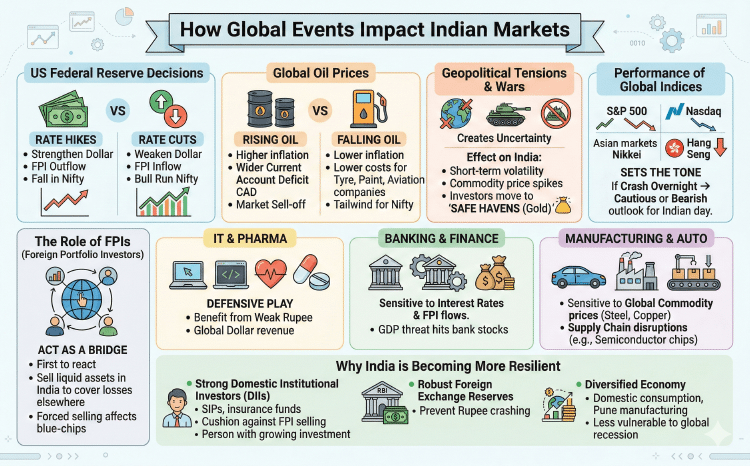
In today’s interconnected world, no economy is an island. For an Indian investor, waking up to check the gift Nifty or the closing numbers of the Wall Street indices has become a morning ritual. Whether it is a change in the interest rates in Washington D.C. or a geopolitical tension in the Middle East, the ripples are felt immediately on Dalal Street. Understanding how global events impact Indian markets is no longer just for institutional traders; it is essential knowledge for every retail investor looking to protect and grow their wealth.
The Concept of a Global Village in Finance
The Indian stock market, represented primarily by the Sensex and Nifty 50, has become increasingly integrated with the global financial system over the last three decades. Foreign Portfolio Investors (FPIs) hold a significant chunk of Indian equities, and our companies rely heavily on global supply chains and international demand. This means that when the global economy sneezes, India often catches a cold—or sometimes, finds a unique opportunity to shine.
Key Global Triggers for the Indian Market
Several specific types of international events consistently move the needle for Indian stocks. Let’s break down the most influential ones.
1. US Federal Reserve Decisions
The US Federal Reserve (the Fed) is arguably the most powerful financial institution in the world. When the Fed changes interest rates, it dictates the flow of “hot money” across the globe.
- Rate Hikes: When the US raises rates, the Dollar becomes stronger. FPIs often pull money out of emerging markets like India to invest in the “safer” and now higher-yielding US Treasury bonds. This lead to a fall in the Indian markets and a weakening Rupee.
- Rate Cuts: Conversely, lower rates in the US encourage investors to seek higher returns in growing economies like India, leading to massive capital inflows and a bull run on the Nifty.
2. Global Oil Prices
India imports nearly 80% of its crude oil requirements. Therefore, the decisions made by OPEC+ or disruptions in oil-producing regions have a direct impact on our fiscal health.
- Rising Oil Prices: High oil prices increase the cost of production and transport in India, leading to inflation. It also widens the Current Account Deficit (CAD), which usually results in a market sell-off.
- Falling Oil Prices: This is generally a “tailwind” for India. It lowers inflation, reduces costs for paint, tyre, and aviation companies, and strengthens the government’s budget.
3. Geopolitical Tensions and Wars
Conflict in any part of the world creates uncertainty. Markets hate uncertainty. Whether it is trade wars between the US and China or physical conflicts, these events trigger a “risk-off” sentiment. Investors move their money out of stocks and into “safe havens” like Gold. For India, these events often cause short-term volatility and spikes in commodity prices.
4. Performance of Global Indices
The sentiment in the US (S&P 500, Nasdaq) and Asian markets (Nikkei, Hang Seng) often sets the tone for the Indian trading day. If the US markets crash overnight, Indian investors usually start the day with a cautious or bearish outlook, regardless of local news.
How Different Sectors in India React
Not every sector reacts the same way to global events. Understanding these nuances can help you rebalance your portfolio effectively.
IT and Pharma: The Defensive Play
The Indian IT sector earns the majority of its revenue in Dollars from the US and Europe. A weakening Rupee (often caused by global instability) actually benefits their bottom line. Similarly, Pharma companies with large export businesses are somewhat shielded from domestic downturns caused by global events.
Banking and Finance
This sector is highly sensitive to interest rate movements and FPI flows. Since banks are the backbone of the economy, any global event that threatens Indian GDP growth or leads to FPI outflows hits bank stocks the hardest.
Manufacturing and Auto
These sectors are sensitive to global commodity prices (like steel and copper) and supply chain disruptions. A global shortage of semi-conductor chips, for example, can halt production lines in Pune or Chennai.
The Role of Foreign Portfolio Investors (FPIs)
FPIs act as a bridge between global events and the Indian market. They are often the first to react to international news. If there is a global liquidity crunch, FPIs sell their liquid assets in India to cover losses elsewhere. This “forced selling” can cause sharp drops in the prices of high-quality Indian blue-chip stocks, even if the companies themselves are doing perfectly well.
Why India is Becoming More Resilient
Despite these global pressures, the Indian market has shown remarkable resilience in recent years. This is due to a few key factors:
- Strong Domestic Institutional Investors (DIIs): Through SIPs and insurance funds, Indian retail investors are pumping record amounts of money into the market. This provides a cushion against FPI selling.
- Robust Foreign Exchange Reserves: The RBI maintains a large chest of Dollars to prevent the Rupee from crashing during global panics.
- Diversified Economy: India’s growth is largely driven by domestic consumption, making us slightly less vulnerable to a global recession compared to export-heavy nations.
Key Takeaways
- The Fed is Crucial: Always keep an eye on US interest rate cycles as they dictate global capital flows.
- Oil is India’s Achilles’ Heel: Significant changes in crude oil prices are a major indicator of future inflation and market direction in India.
- Currency Correlation: A strengthening US Dollar usually puts pressure on the Indian stock market in the short term.
- Volatility vs. Trend: Global events often cause short-term volatility, but the long-term trend of the Indian market is driven by domestic earnings and economic growth.
- Diversification is Essential: Holding a mix of export-oriented (IT/Pharma) and domestic-focused (Banks/FMCG) sectors can protect your portfolio from specific global shocks.
Conclusion
While it is impossible to predict every global event, being aware of how they influence the Indian landscape allows you to stay calm during market turbulence. Smart investing isn’t about avoiding volatility; it’s about understanding its source. By keeping a pulse on international developments—from central bank meetings to geopolitical shifts—you can distinguish between a temporary global panic and a genuine change in India’s economic story.
Remember, for a long-term investor, global-event-driven crashes often provide the best “buy on dip” opportunities in high-quality Indian companies. Stay informed, stay diversified, and keep your eyes on the long-term horizon.