
How to Build a Diversified Investment Portfolio
Learn the essential steps to build a diversified investment portfolio in India. Explore asset allocation, risk management, and how to balance stocks, bonds, and mutual funds for long-term wealth.

- NV Trends
- 6 min read
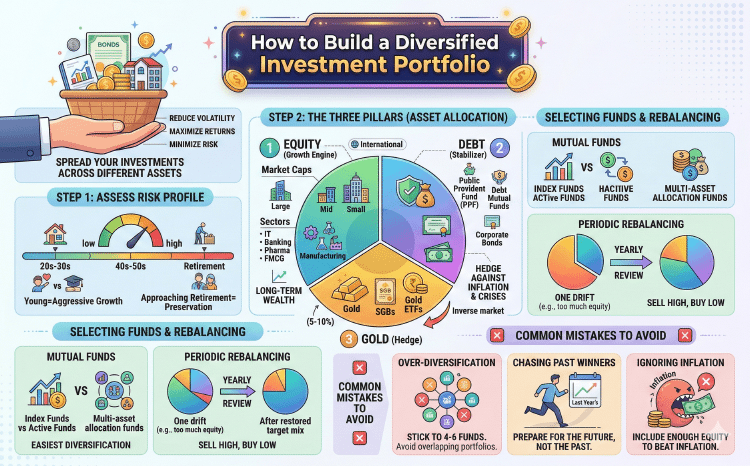
Building wealth in the Indian market requires more than just picking a few winning stocks or putting money into a random mutual fund. The secret to long-term financial success lies in a concept that seasoned investors swear by: diversification. You might have heard the old saying, “Don’t put all your eggs in one basket.” In the world of finance, this is the foundation of portfolio construction.
A diversified investment portfolio helps you navigate the volatile waves of the stock market, protecting your hard-earned money during downturns while allowing it to grow during bull runs. For Indian investors facing a unique landscape of high growth potential and periodic market corrections, understanding how to spread investments across different asset classes is crucial.
What is Portfolio Diversification?
Portfolio diversification is the practice of spreading your investments across various financial instruments, industries, and other categories. The goal is to maximize returns by investing in different areas that would each react differently to the same event. While it doesn’t guarantee against loss, diversification is the most important component of reaching long-range financial goals while minimizing risk.
In India, this means not just sticking to equity (stocks) but also looking at debt (bonds and FDs), gold, and perhaps real estate. When one sector or asset class underperforms, another might perform well, balancing out the overall health of your portfolio.
Key Takeaways
- Diversification reduces the impact of volatility on your total investment.
- Asset allocation should be based on your age, goals, and risk appetite.
- Include a mix of Equity, Debt, and Gold for a well-rounded Indian portfolio.
- Rebalancing your portfolio once a year is essential to maintain your target mix.
- Systematic Investment Plans (SIPs) are the best tool for disciplined diversification.
Step 1: Assess Your Risk Profile
Before you buy your first share or fund, you must understand your own relationship with risk. Are you someone who can stay calm when the Nifty drops 10% in a week? Or do you prefer the steady, guaranteed returns of a Fixed Deposit?
Age and Time Horizon
Generally, younger investors in their 20s and 30s can afford to take more risks because they have decades to recover from market slumps. As you approach retirement, your focus should shift from aggressive growth to wealth preservation.
Financial Goals
Define what you are investing for. Is it a down payment for a house in 5 years? Or is it for a retirement fund 25 years away? Short-term goals require safer, debt-heavy portfolios, while long-term goals benefit from the compounding power of equity.
Step 2: The Three Pillars of Indian Asset Allocation
A solid Indian portfolio usually stands on three main pillars: Equity, Debt, and Gold.
1. Equity (The Growth Engine)
Equity is where you build real wealth. This includes direct stocks and equity mutual funds. To diversify within equity:
- Market Cap Diversification: Spread money across Large-cap (stable companies), Mid-cap (growth potential), and Small-cap (high risk, high reward) funds.
- Sector Diversification: Avoid putting all your money into just Banking or IT. Include Pharma, FMCG, and Manufacturing to stay protected against sector-specific downturns.
2. Debt (The Stabilizer)
Debt instruments provide stability and regular income. They include Public Provident Fund (PPF), Debt Mutual Funds, Corporate Bonds, and Fixed Deposits. When the stock market is volatile, the debt portion of your portfolio acts as a cushion, ensuring your total portfolio value doesn’t crash.
3. Gold (The Hedge)
In India, gold is more than just jewelry; it is a financial hedge. Gold often moves in the opposite direction of the stock market. During global crises or high inflation, gold prices tend to rise. Allocating 5-10% of your portfolio to Sovereign Gold Bonds (SGBs) or Gold ETFs is a smart diversification move.
Step 3: Selecting the Right Mutual Funds
For most retail investors, mutual funds are the easiest way to achieve diversification. Instead of buying 50 different stocks, you buy one fund that holds those 50 stocks for you.
Index Funds vs. Active Funds
Index funds track a specific index like the Nifty 50. They are low-cost and provide instant diversification across India’s largest companies. Active funds are managed by experts who try to beat the market. A mix of both can be beneficial.
Hybrid Funds
If you find managing different funds confusing, consider Multi-Asset Allocation funds or Balanced Advantage Funds. These funds automatically spread your money across equity, debt, and sometimes gold, doing the diversification work for you.
Step 4: The Importance of International Diversification
While the Indian economy is growing fast, it is also important to have some exposure to global markets, particularly the US market. By investing in International Mutual Funds, you benefit from the growth of global giants like Google, Amazon, and Microsoft. This also protects you against the depreciation of the Rupee against the Dollar.
Step 5: Periodic Rebalancing
Diversification is not a “set it and forget it” task. Over time, your asset allocation will change because different assets grow at different speeds. For example, if the stock market has a fantastic year, your equity portion might grow from 60% to 75% of your portfolio. This makes your portfolio riskier than you intended.
Rebalancing involves selling a portion of the asset that has grown too large and buying more of the asset that has lagged. Doing this once a year ensures you are “selling high and buying low” consistently.
Common Mistakes to Avoid
Over-diversification
Holding 30 different mutual funds does not mean you are 30 times safer. Often, many funds hold the same stocks (portfolio overlap). Stick to 4-6 well-chosen funds across different categories to keep your portfolio manageable.
Chasing Last Year’s Winners
Just because Small-cap funds gave 50% returns last year doesn’t mean you should move all your money there now. Diversification is about preparing for the future, not chasing the past.
Ignoring Inflation
If your “safe” investments give you 6% returns but inflation is at 7%, you are actually losing purchasing power. You must include enough equity to ensure your portfolio beats inflation over the long run.
Conclusion
Building a diversified investment portfolio is a journey, not a destination. It requires patience, discipline, and a clear understanding of your financial landscape. By spreading your investments across various asset classes and sectors, you protect yourself from the unpredictable nature of the markets while setting the stage for consistent wealth creation.
Start small, stay consistent with your SIPs, and review your plan annually. In the world of investing, the person who survives the longest usually wins, and diversification is your best tool for survival.