
Beginner’s Guide to Stock Market Investment
A comprehensive guide for Indian beginners looking to start their journey in the stock market, covering basics, demat accounts, and smart investing tips.

- NV Trends
- 6 min read
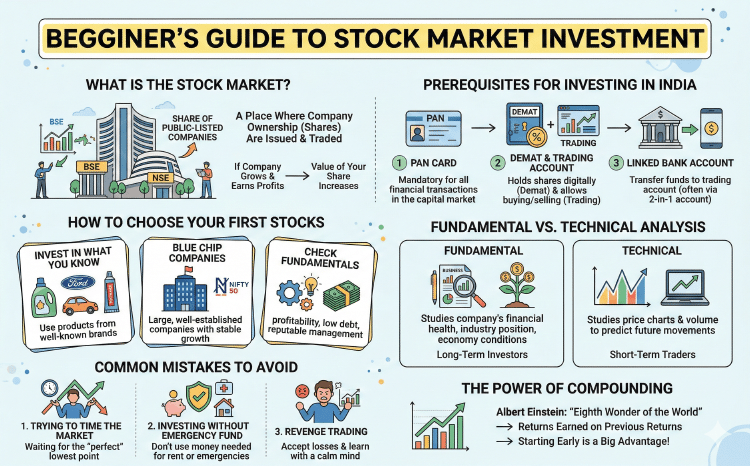
The Indian stock market has seen a massive surge in interest over the last few years. From young professionals in Bengaluru to shopkeepers in Indore, everyone is talking about “Sensex,” “Nifty,” and “Multibaggers.” However, for a complete beginner, the world of trading and investing can feel like a complex maze filled with jargon. If you have ever wondered how to start your journey in the stock market but felt overwhelmed by the numbers, this guide is for you.
Investing in stocks is one of the most effective ways to build long-term wealth. Unlike keeping money in a savings account where inflation eats away at your purchasing power, the stock market allows you to become a partial owner of India’s growing businesses.
What Exactly is the Stock Market?
In simple terms, a stock market is a place where shares of public-listed companies are issued and traded. When you buy a “share,” you are essentially buying a small piece of ownership in that company. If the company grows and earns profits, the value of your share increases.
In India, there are two primary stock exchanges:
- Bombay Stock Exchange (BSE): The oldest stock exchange in Asia.
- National Stock Exchange (NSE): The largest exchange in India in terms of daily turnover.
Key Takeaways
- Stock market investment is a marathon, not a sprint; focus on the long term.
- You must have a PAN card and a Demat account to start investing in India.
- Never invest money that you might need for emergencies in the next 1-2 years.
- Diversification is the best tool to manage risk in your portfolio.
- Start small and increase your investment as your confidence and knowledge grow.
Prerequisites for Investing in India
Before you can place your first buy order, you need to set up the necessary infrastructure. Fortunately, the digital revolution in India has made this process incredibly simple and paperless.
1. PAN Card
A Permanent Account Number (PAN) is mandatory for all financial transactions in the Indian capital market. It is used by the government to track your tax liabilities.
2. Demat and Trading Account
You cannot hold physical share certificates anymore. A Demat Account (short for Dematerialized) acts like a digital locker for your shares. A Trading Account is the platform you use to buy and sell those shares. Most modern brokers in India offer a 2-in-1 account that combines both.
3. Linked Bank Account
You need a bank account to transfer funds to your trading account. Any major Indian bank (public or private) will work. Ensure your mobile number is updated for OTP-based verifications.
How to Choose Your First Stocks
Many beginners make the mistake of following “tips” from WhatsApp groups or YouTube “gurus.” This is the fastest way to lose money. Instead, use a logical approach to pick your first few investments.
Invest in What You Know
Look around your house. Do you use a specific brand of toothpaste? Do you use a particular bank? Do you drive a certain brand of car? Chances are, these companies are listed on the stock market. Investing in businesses whose products you understand makes it easier to track their progress.
Look for “Blue Chip” Companies
For a beginner, the safest starting point is “Blue Chip” stocks. These are large, well-established companies with a long track record of stable growth and dividend payments. Companies that are part of the Nifty 50 index are generally considered the pillars of the Indian economy.
Check the Fundamentals
You don’t need to be a Chartered Accountant, but you should check a few basic things:
- Profitability: Is the company making money consistently?
- Debt: Does the company owe too much money to banks?
- Management: Is the company run by reputable people?
Fundamental vs. Technical Analysis
There are two main schools of thought when it comes to the stock market:
Fundamental Analysis
This involves studying the company’s financial health, industry position, and economic conditions. This is the preferred method for long-term investors who want to buy and hold shares for years.
Technical Analysis
This involves studying price charts and volume to predict future price movements. This is mostly used by short-term traders who want to profit from market volatility. For a beginner, focusing on fundamental analysis is usually more rewarding and less stressful.
Common Mistakes to Avoid
The stock market is a place where “patience pays and greed costs.” Here are the most common pitfalls:
1. Trying to Time the Market
Beginners often wait for the “perfect” time to buy when the market is at its lowest. In reality, no one can consistently predict market bottoms. The best time to start was yesterday; the second-best time is today.
2. Investing Without an Emergency Fund
Never use the money kept for your rent, children’s school fees, or medical emergencies for stocks. The market can be volatile in the short term, and you don’t want to be forced to sell your shares at a loss because you need cash urgently.
3. Revenge Trading
If you lose money on a stock, don’t immediately try to “win it back” by taking bigger risks. Accept the loss, learn from the mistake, and move on with a calm mind.
The Power of Compounding
Albert Einstein reportedly called compounding the “eighth wonder of the world.” In the stock market, compounding happens when you earn returns on your previous returns.
For example, if you invest ₹10,000 and it grows by 10%, you have ₹11,000. Next year, that 10% growth happens on ₹11,000, not just the original ₹10,000. Over 10, 20, or 30 years, this effect creates massive wealth. This is why starting early is the biggest advantage a young investor has.
Building a Diversified Portfolio
“Don’t put all your eggs in one basket” is the golden rule of investing. If you put all your money into one company and that company faces a crisis, your entire savings are at risk.
A well-diversified portfolio for an Indian beginner might look like this:
- 60% Large-cap stocks: Stable companies for steady growth.
- 20% Mid-cap stocks: Emerging companies with higher growth potential.
- 20% Small-cap or Sector-specific stocks: High-risk, high-reward picks.
Alternatively, many beginners find it easier to start with an Index Fund. An index fund automatically invests your money in the top 50 or 100 companies in India, providing instant diversification with very low fees.
Conclusion
The Indian stock market is a land of opportunity for those who approach it with discipline and a learning mindset. It is not a gambling den or a “get-rich-quick” scheme. It is a tool for participation in the nation’s economic success.
Start small, keep reading, and stay patient. Over time, your small monthly investments can grow into a substantial corpus that provides financial freedom for you and your family. Welcome to the world of investing!