
How to Analyze a Fund House Performance
Learn the essential steps to evaluate an Asset Management Company (AMC) in India. Discover how to look beyond returns to find a reliable fund house for your long-term investments.

- NV Trends
- 5 min read
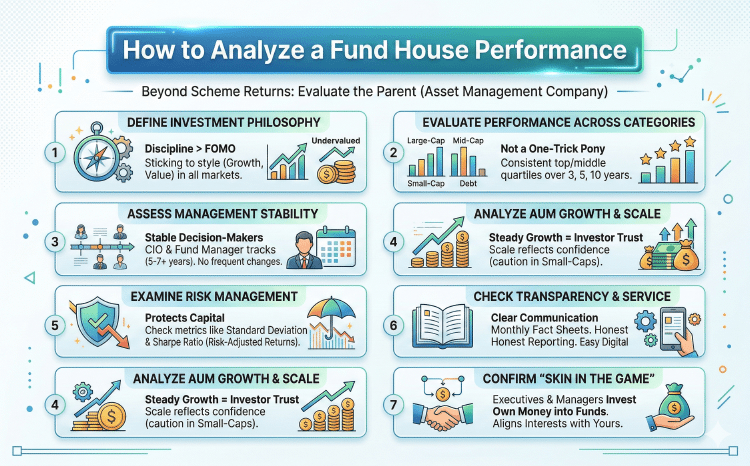
When most Indian investors think about mutual funds, they immediately jump to comparing the “star ratings” or the last one-year returns of a specific scheme. While the performance of an individual fund is important, many overlook the “parent” of that fund—the Asset Management Company (AMC) or the Fund House.
In India, where there are over 40 AMCs managing trillions of rupees, choosing the right fund house is just as critical as choosing the right scheme. A fund house’s philosophy, management stability, and internal processes determine how your money will be handled during both market highs and scary lows.
In this comprehensive guide, we will walk through the essential metrics and qualitative factors you should use to analyze a fund house’s performance effectively.
Why the Fund House Matters
Think of a fund house like a kitchen and the individual mutual fund schemes as the dishes. Even if one dish tastes good today, you want to be sure the kitchen follows hygiene standards, has experienced chefs, and uses quality ingredients consistently. If the kitchen’s management is messy, even the best dish will eventually lose its quality.
Similarly, an AMC provides the framework, research, and risk management systems that all its fund managers must follow. A strong fund house ensures that even if a star fund manager leaves, the fund’s performance doesn’t collapse because the “process” is bigger than the individual.
Key Takeaways
- Look for consistency across multiple schemes, not just one “star” performer.
- Evaluate the experience and stability of the Chief Investment Officer (CIO) and fund managers.
- Check the Assets Under Management (AUM) growth as a sign of investor trust.
- Prioritize fund houses with a clear, documented investment philosophy.
- Analyze the risk-adjusted returns and the “active share” of the portfolio.
1. Analyze the Investment Philosophy
Every reputable fund house in India has a core belief system. Some are “Growth” oriented, looking for companies with high earnings potential regardless of price. Others are “Value” oriented, looking for undervalued stocks that the market has ignored.
As an investor, you need to know if the fund house stays true to its philosophy. If a “Value” house starts buying expensive “Growth” stocks just because of market FOMO (Fear Of Missing Out), it’s a red flag. A disciplined AMC sticks to its process even when that particular style is out of favor in the short term.
2. Evaluate Performance Across Categories
A great fund house shouldn’t be a “one-trick pony.” If an AMC has one top-performing small-cap fund but all its large-cap, mid-cap, and debt funds are struggling in the bottom quartile, it suggests that the success of that one fund might be luck or dependent on a single individual.
Check the performance of the AMC across different categories. A robust fund house usually has several schemes performing consistently in the top or middle quartiles over 3, 5, and 10-year periods. This indicates that the AMC’s internal research and stock-selection process is working across the board.
3. Assessing Management Stability and Experience
In the Indian mutual fund industry, fund manager movements are common. However, frequent “musical chairs” at the top levels—such as the CEO or CIO—can lead to inconsistent strategies.
When analyzing a fund house, look at the tenure of its key decision-makers. How long has the CIO been with the firm? Do the fund managers have a track record of staying for at least 5 to 7 years? Stability at the top usually leads to a more disciplined and long-term approach to wealth creation.
4. Assets Under Management (AUM) and Growth
While “bigger” isn’t always “better,” the AUM of a fund house tells you a story about investor confidence. If an AMC is consistently losing AUM while the rest of the industry is growing, it might indicate service issues, poor performance, or a lack of trust from institutional investors.
Conversely, steady growth in AUM over several years suggests that the AMC is doing something right. However, for specific categories like Small-Cap funds, be wary of fund houses where the AUM has grown too large too quickly, as it can sometimes make it difficult for the manager to buy and sell stocks without affecting the market price.
5. Risk Management Framework
A fund house’s performance isn’t just about the returns it generates; it’s about the risks it took to get there. During a bull market, almost everyone looks like a genius. The true test of an AMC is how much it protects your capital during a market crash.
Check metrics like the Standard Deviation (volatility) and Sharpe Ratio (risk-adjusted returns) for their major funds. An AMC that delivers slightly lower returns than the topper but with much lower volatility is often a better choice for conservative, long-term investors.
6. Transparency and Investor Service
How well does the fund house communicate with its investors? A transparent AMC provides detailed fact sheets every month, clearly explains its investment decisions, and is honest when a fund underperforms.
In the digital age, the ease of using the AMC’s website or mobile app for transactions and tracking also adds to the overall “performance” of the fund house from a user perspective. If you find it difficult to get your queries resolved or the documentation is opaque, it might be better to look elsewhere.
7. The Importance of “Skin in the Game”
The Securities and Exchange Board of India (SEBI) now requires AMCs and fund managers to invest their own money into the schemes they manage. This is a great metric for investors. Check if the fund house’s executives are significantly invested in their own funds. When their “skin” is in the game, their interests are perfectly aligned with yours.
Conclusion
Analyzing a fund house requires moving beyond the “Current NAV” and “1-Year Return” mindset. It involves looking at the DNA of the company—its people, its processes, and its principles.
Before you start your next SIP, spend some time researching the AMC. A fund house that values process over personality and consistency over quick gains will likely be your best partner in your journey toward financial freedom. By choosing a reliable fund house, you aren’t just buying a product; you are buying peace of mind.